
Why Patients Choose Orchidectomy Without Vaginoplasty
Patients usually fall into three main groups depending on their long-term surgical goals:
At WIH International Hospital in Bangkok, led by Dr. Chettasak (Dr. Chet’s NPI), we provide comprehensive gender-affirming surgical options tailored to individual needs. While many transgender women choose full gender-affirming surgery (GAS) with vaginoplasty, others prefer orchidectomy without vaginoplasty.
This procedure is recognized by the WPATH Standards of Care (SOC-8) as a valid form of gender-affirming surgical treatment. For some patients, orchidectomy is the final step of gender affirmation; for others, it is an interim stage before future vaginoplasty.
Patients usually fall into three main groups depending on their long-term surgical goals:
At WIH International Hospital, orchidectomy is performed with meticulous technique to ensure both safety and the preservation of future surgical options:
The procedure is performed under either general anesthesia or twilight sedation (intravenous sedation with local anesthesia), managed by our anesthesiology team for maximum safety, comfort, and smooth recovery.
The preferred incision is made at the midline of the scrotum, providing excellent exposure, minimal visible scarring, and optimal preservation of surrounding tissues.
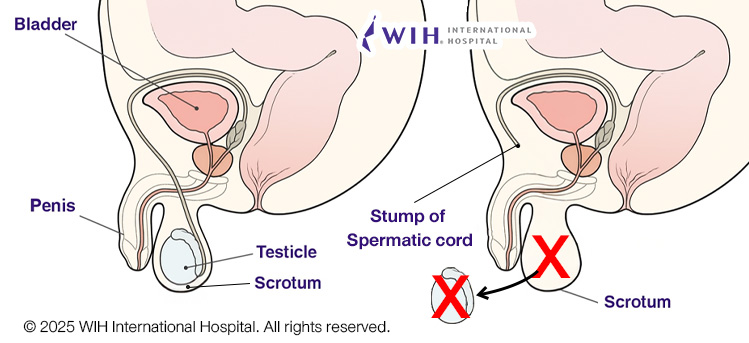
spermatic cord, and the stump is ligated as close as possible to the external inguinal ring to prevent residual androgen activity.
The cord contains the vas deferens, the testicular vessels (artery and pampiniform plexus of veins), and nerves. Careful dissection is performed to avoid injury to surrounding structures.
If abnormalities such as varicocele (dilated veins) or lipoma of the cord are found, these can be safely removed during the same surgery.
A cautery cut is routinely used when dividing the cord, reducing the risk of neuropathic pain caused by neuroma formation.
In every case, the scrotal skin is preserved carefully for potential future use in gender-affirming surgery, such as skin-graft vaginoplasty.
A pressure dressing is applied to the scrotal area immediately after surgery. This helps minimize bleeding and prevents prolonged swelling, ensuring smoother recovery.
Modern orchidectomyis a safe, ethical, and medically supervised procedure recognized by WPATH as gender-affirming care. In contrast, historical castration of eunuchs in ancient China involved the removal of both penis and testicles without anesthesia, often leading to extreme pain, urinary complications, and lifelong hormonal consequences.
While eunuchs endured social isolation and regret, today’s orchidectomy provides relief from gender dysphoria, improved health, and enhanced quality of life. The key difference lies in purpose, safety, and patient consent, reflecting how far medicine and human rights have advanced.
👉 Learn more in our WIH Educational Blog on Historical Castration.
Orchidectomy without vaginoplasty is a safe and recognized gender-affirming surgical option. For many, it is the final step of gender affirmation, while for others, it serves as an interim stage before full GAS.
At WIH International Hospital, under the expertise of Dr. Chettasak, all procedures follow WPATH SOC-8 guidelines to ensure safe, ethical, and affirming care for every patient.
At WIH, we believe that gender-affirming surgery is about more than just physical transformation — it’s about aligning your body with your identity, so you can live confidently as your authentic self.
While many transgender women choose full gender-affirming surgery (GAS) with vaginoplasty, others prefer orchidectomy without vaginoplasty.
This procedure is recognized by the WPATH Standards of Care (SOC-8) as a valid form of gender-affirming surgical treatment. For some patients, orchidectomy is the final step of gender affirmation; for others, it is an interim stage before future vaginoplasty.
These patients already intend to undergo full gender-affirming surgery in the near future.
They request orchidectomy earlier to avoid or reduce the use of androgen blockers, which may cause side effects such as liver inflammation or cardiovascular risks.
By removing the testicles, testosterone levels drop significantly (around 95%reduction), eliminating the need for long-term anti-androgen medication.
However, if vaginoplasty is delayed for more than 1–2 years, the scrotal skin may shrink, limiting the option of skin-graft vaginoplasty and potentially requiring more complex procedures such as colon vaginoplasty or peritoneal vaginoplasty (PPV).
Once performed, orchidectomy cannot be reversed.
Patients will no longer be able to produce sperm or have biological children unless sperm is cryopreserved before surgery.
The procedure is performed under either general anesthesia or twilight sedation (intravenous sedation with local anesthesia), managed by our anesthesiology team for maximum safety, comfort, and smooth recovery.
The preferred incision is made at the midline of the scrotum, providing excellent exposure, minimal visible scarring, and optimal preservation of surrounding tissues.
In every case, the scrotal skin is preserved carefully for potential future use in gender-affirming surgery, such as skin-graft vaginoplasty.
A pressure dressing is applied to the scrotal area immediately after surgery. This helps minimize bleeding and prevents prolonged swelling, ensuring smoother recovery.

Ready to learn more, or need support with your dilation routine? Contact Dr. Chettasak’s team at WIH International Hospital.